
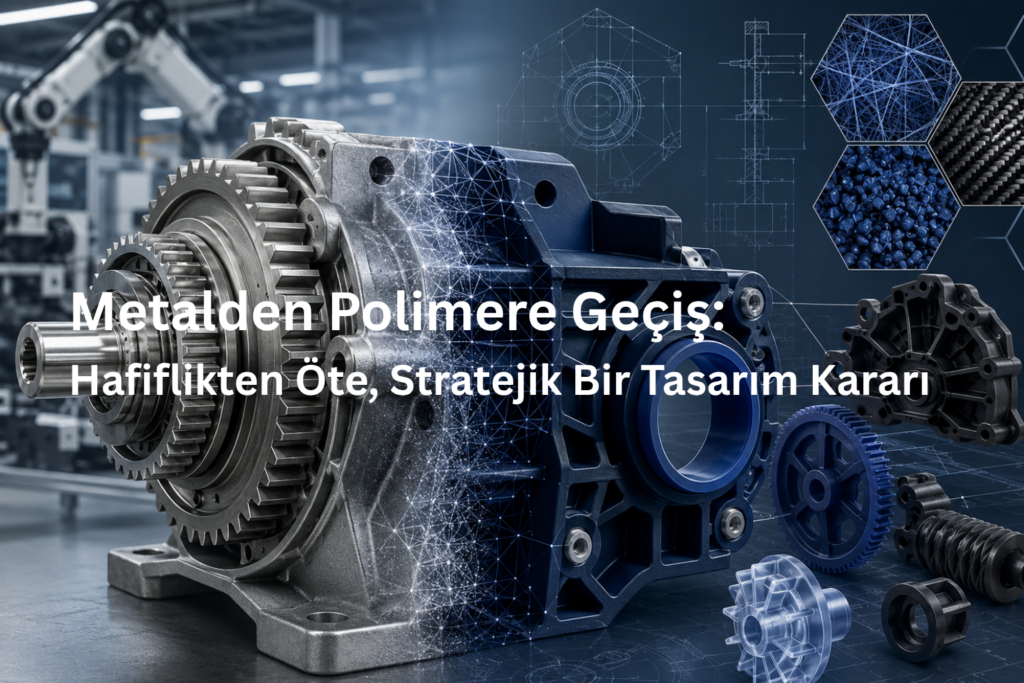
In industry, metal has long been regarded as the “default material” due to its durability, reliability, and established production practices. However, this approach has been gradually changing in recent years. Today, in many industries, the key question is no longer whether a part can be made from metal; rather, it is whether the same function can be achieved using plastics or engineering polymers—materials that are lighter, more cost-effective, easier to form, and offer a more integrated design. Post-2019 literature and industry technical publications indicate that this transformation is accelerating, particularly around engineering plastics such as POM, PA, PPA, PPS, and PEEK.
This shift is driven by more than just weight reduction. Plastics and engineering polymers offer advantages such as reducing the number of parts, enabling the production of complex geometries in a single piece, minimizing corrosion issues, and reducing the need for coatings and finishing in certain applications. Asahi Kasei’s “metal replacement” approach sums this up quite clearly: replacing a metal part with a plastic equivalent does more than just reduce weight; it can also simplify production processes and alleviate cost pressures.
However, the most critical point here is this: the transition from metal to plastic is not simply about producing the same part in the same form using a different material. What makes the real difference in successful projects is rethinking and redesigning the part, and revising the engineering concept to suit polymer behavior. A 2025 systematic review also emphasizes that engineering plastics hold significant potential for industrial production, but that limitations such as heat resistance, dimensional stability, and sensitivity to application conditions must be properly managed.
In Turkey, this transformation has become particularly evident in the automotive supply industry and the thermoplastic processing sector. In a 2019 study by Demir and Ay, the ultrasonic welding of plastic injection-molded parts used in the automotive sector is examined, and it is demonstrated that high-quality and efficient joints can be achieved with the appropriate parameters. The key point of the study is this: the use of plastic parts alone is not enough; joining technology has also become a key component of product success.
Similarly, a 2023 review published by Uludağ University states that plastic welding technologies for engine components such as thermostats and water pumps are a method suitable for mass production, cost-effective, and capable of meeting automotive requirements. The same article clearly states that the shift from metal to plastic, particularly in electric vehicles, has become even more critical in terms of reducing vehicle weight. This indicates that the topic is now being addressed not only theoretically but also with a direct focus on practical application in Turkey’s local academic literature.
From a materials perspective, the first group to stand out in everyday industrial applications consists of engineering plastics such as POM and PA. These materials are frequently used, particularly in gears, bushings, bearing housings, and friction-bearing moving parts. A 2021 study by Hriberšek and colleagues shows that the most common pairings in polymer gears are POM/PA, steel/POM, PA/PBT, and steel/PA; however, the steel/PEEK combination stands out in applications requiring higher performance. The same study emphasizes that, unlike metal, performance in polymer gears is much more sensitive to temperature, and the primary types of damage include wear, pitting, root fracture, and melting. In other words, plastics are a strong alternative, but they are not materials that can be managed using “metal logic.”
The key takeaway here is that the performance of polymer parts cannot be determined solely by consulting the material datasheet. Actual operating conditions, temperature rise, friction, load type, and process parameters have a significant impact on performance. Data from Hriberšek and colleagues demonstrate that the mechanical behavior of polymer gears is directly related to thermal processes and that temperature increases in the range of 80 to 120 °C can be decisive for service life. This highlights that laboratory data alone is insufficient when transitioning from metal to plastic, and that the actual operating scenario must be verified.
When it comes to more demanding thermal and chemical environments, high-performance thermoplastics such as PPS and PPA come to the fore. As an example from Turkey, Sevdaroğlu’s 2020 study at Istanbul Technical University (İTÜ) examines the production of PPS tubing for engine cooling systems and notes that this material can be preferred over ceramic and metal materials thanks to its advanced properties. This serves as a valuable local example demonstrating that engineering plastics have now become a stronger contender in automotive subsystems requiring high-temperature and chemical resistance.
The same trend is evident in the automotive sector. Syensqo’s Ryton® PPS technical content demonstrates that PPS can withstand high temperatures, mechanical stress, and aggressive automotive fluids in under-the-hood applications, brake systems, and electrical and electronic components; and when used as a metal replacement, it can eliminate corrosion, reduce fuel consumption, lower costs, and improve system integration. This demonstrates that PPS is positioned not merely as a “high-performance plastic” but as a direct metal replacement material.
Similarly, PPA stands out in applications requiring high-temperature tolerance. According to Celanese’s technical documentation, PPA-based polymers are used in place of metal in molded components, particularly in automotive powertrain parts and components exposed to high temperatures. This family of materials is particularly well-suited for applications requiring creep resistance, dimensional stability, and chemical resistance at high temperatures.
In the higher performance class, PEEK deserves its own section. According to a 2021 review by Yu and Liu, PEEK is widely used as a substitute for metal, particularly in orthopedic applications. This is not only due to its strength but also to its chemical resistance, high-temperature resistance, fatigue performance, low wear rate, and, in some applications, more advantageous elastic behavior compared to metal. Victrex’s industry data also demonstrates that PEEK seriously challenges metal in applications involving high temperatures, high pressures, and corrosive environments; it has now become a viable alternative for high-performance gears.
All of this tells us that the transition from metal to polymer is not a “material change,” but a system design decision. Successful projects are typically those that can answer the following four questions together: Has the part been redesigned? Have operating temperatures and friction conditions been realistically tested? Has the joining or assembly method been optimized for polymer behavior? Have total system cost and production efficiency been evaluated together? Sources from 2019 onward show that when these questions are answered effectively, engineering plastics can become not just an alternative but a smarter solution in many applications.
Result
Today, the shift from metal to plastic is not merely the result of a quest for lightweighting; it is the combined outcome of goals such as production efficiency, design flexibility, corrosion resistance, system integration, and cost optimization. However, this transformation only becomes meaningful when the right polymer is used for the right part through the right process. The rise of engineering plastics does not mean completely eliminating metal; rather, it seriously challenges the assumption that “metal should be the default material” in many applications. This is precisely the common message of the literature since 2019.
Sources
Demir, A., & Ay, İ. (2019). Ultrasonic Welding of Thermoplastic Materials and the Effect of Welding Parameters on Tensile Strength. International Journal of Technological Sciences.
Kıyılı, O. (2023). Plastic Joining Methods: Ultrasonic and Vibration Welding. Journal of the Faculty of Engineering, Uludağ University.
Sevdaroğlu, M. (2020). Production of polyphenylene sulfide (PPS) tubing for engine cooling systems using the extrusion method and optimization of production parameters. Istanbul Technical University.
Hriberšek, M., et al. (2021). Durability testing and characterization of POM gears. Wear.
Yu, Y.-H., & Liu, S.-J. (2021). Polyetheretherketone for orthopedic applications: a review. Current Opinion in Chemical Engineering.
Ikpe, A. E., Itiat, N. E., & Ekanem, I. I. (2025). A Systematic Review of Engineering Plastics and Their Viability in Conventional Industrial and Manufacturing Processes. Journal of Materials and Manufacturing Technology.
